WELCOME TO
“Making astronomy accessible to students and curious minds through stories, science, observation, and exploration.”
Week: 8/23/2026
SATURN
Saturn is the sixth planet from the Sun and is best known for its spectacular ring system made of ice, rock, and dust. It is a gas giant composed mostly of hydrogen and helium, with powerful winds and dozens of moons orbiting around it. Saturn’s rings and unusual atmosphere make it one of the most recognizable and studied planets in the Solar System.

Week: 5/30/2026
TITAN
Titan is the largest moon of Saturn and the only moon in the solar system with a thick atmosphere. Its surface contains rivers, lakes, and seas of liquid methane and ethane, making it one of the most Earth-like worlds in terms of weather and geological activity. Scientists are especially interested in Titan because its complex chemistry may provide clues about how the building blocks of life can form.

Week: 9/4/2026
NEPTUNE
Neptune is the eighth and farthest major planet from the Sun, orbiting about 4.5 billion kilometers away. Known for its deep blue appearance, Neptune is an ice giant with an atmosphere made mostly of hydrogen, helium, and methane. Despite receiving very little energy from the Sun, it has the fastest planetary winds in the Solar System, reaching speeds of over 2,000 kilometers per hour. Neptune also has a system of faint rings and 16 known moons, including Triton, its largest moon.

Week: 5/17/2026
EUROPA
Europa is one of Jupiter’s largest moons and is covered by a smooth, icy surface filled with long cracks. Scientists believe a global ocean of liquid water may exist beneath its frozen crust, making Europa one of the most exciting places to search for possible life beyond Earth. Jupiter’s strong gravity creates tidal forces that may help keep this hidden ocean warm, making Europa an important target for future space missions.

Week: 4/26/2026
QUASAR 3C 273
Quasar 3C 273 is one of the brightest and most famous quasars ever discovered, located billions of light-years from Earth. It is powered by a supermassive black hole feeding on surrounding matter, releasing enormous amounts of energy that outshines entire galaxies. Because its light has traveled for billions of years to reach us, studying it helps astronomers learn about the early universe.

Week: 4/18/2026
ANDROMEDA GALAXY
The Andromeda Galaxy is the closest major galaxy to the Milky Way, located about 2.5 million light-years from Earth. It is a large spiral galaxy containing around one trillion stars and can be seen with the naked eye as a faint blur in a dark sky. Andromeda is moving toward the Milky Way and is expected to merge with our galaxy in about 4 to 5 billion years, helping scientists study how galaxies evolve over time.

Week: 4/10/2026
SAGGITARIUS A
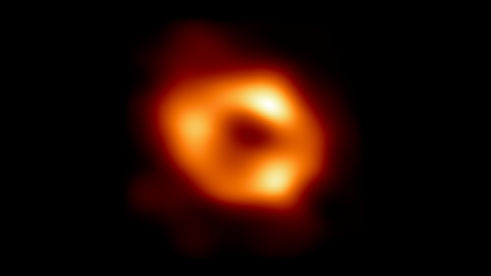
Sagittarius A is the supermassive black hole at the center of the Milky Way, with a mass about 4 million times that of the Sun. It is located around 26,000 light-years from Earth in the direction of the constellation Sagittarius. Although it cannot be seen directly, its presence is revealed by the motion of nearby stars and energy emitted by matter falling into it.
Week: 4/2/2026
MERCURY
Mercury happens to be the tiniest planet in our solar system and the nearest one to the Sun, completing an orbit around it in 88 Earth days. It is a rocky, heavily cratered planet with enormous changes in temperature (from 800F to -300F) because it has a very thin atmosphere. Surprisingly, even though it is nearest to the Sun, it is not the hottest; Venus takes that crown.
